
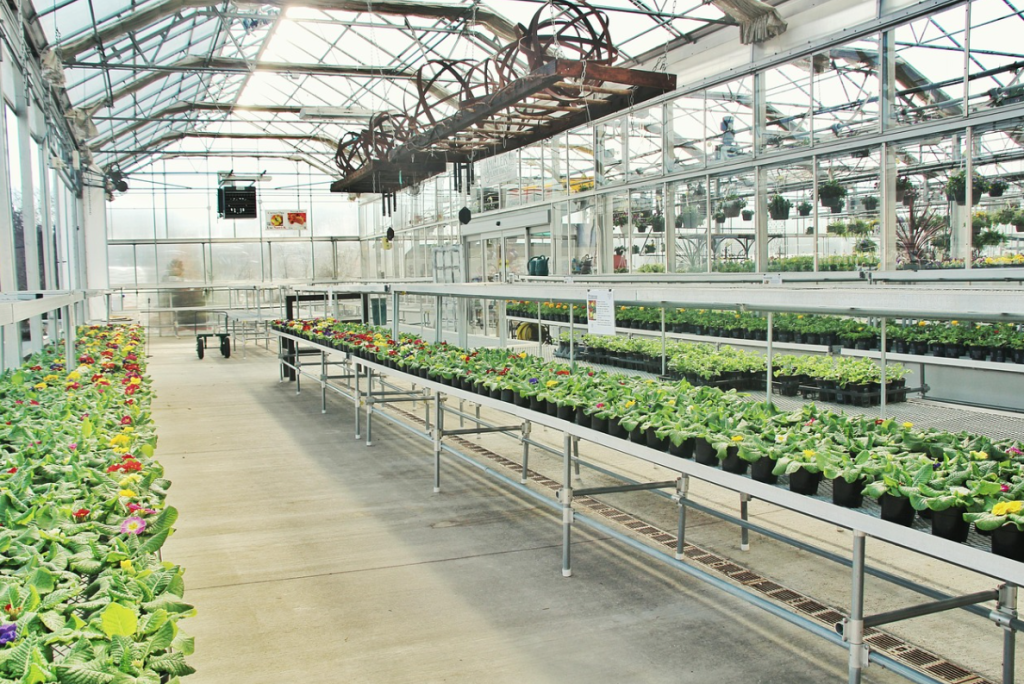
In commercial greenhouse production, climate instability is rarely caused by a lack of equipment. More often, it is the result of equipment reacting too quickly, too late, or all at once.
Instead of allowing systems to fight one another, a superior strategy is to assign each asset a specific, sequential role:
- Shading intercepts initial solar spikes.
- Vents manage natural heat and moisture evacuation.
- Fans normalize air distribution before energy-intensive cooling steps are triggered.
By establishing a clear temperature setpoint and a humidity or Vapour Pressure Deficit (VPD) target, complemented by a protective buffer zone (deadband), you prevent rapid on-off cycling of equipment and give your controller the room it needs to stabilize the environment.
The Step-by-Step Equipment Sequence
To maximize efficiency and crop health, equipment should be deployed in a logical, tiered hierarchy:
1. Shading (The First Line of Defense)
Deploying shades is typically the first stage of defense, especially on bright mornings when solar gain climbs ahead of air temperature. Deploying or partially closing shade curtains early limits heat buildup, drastically reducing the workload on vents and fans later in the day.
2. Incremental Venting (Natural Evacuation)
Vents should actuate in small increments rather than jumping from completely closed to fully open.
- Roof vents should crack open first to release rising heat.
- Side vents can follow if heat continues to build or if humidity remains stubbornly high.
This stepped approach eliminates harsh drafts and maintains a steadier canopy microclimate.
3. Air Circulation & Exhaust Fans (The Balancer)
Circulation fans (such as horizontal airflow fans) should run continuously as a balancing layer to eliminate hot and cool pockets. Mechanical exhaust fans should only be staged when shading and natural venting can no longer keep conditions within your deadband.
Integrating Humidity into the Equation
A common pitfall in greenhouse or indoor facility management is staging equipment based solely on temperature. In reality, humidity drives disease pressure, condensation, and transpiration rates. Your automated stages must respond to moisture levels just as dynamically as they do to heat.
| Environmental Scenario | Optimized Staged Response |
|---|---|
| Mild but Damp Day | Activate venting or fan support to purge moisture, even if air temperature is perfectly on target. |
| Hot and Dry Day | Lead with shading to block heat, keeping venting moderate to prevent drying out the crop too quickly. |
Eliminating the Need for Manual Adjustments
To prevent your systems from over-correcting, your automation software must utilize hysteresis and time delays between stages. A system should never trigger the next tier of equipment the exact second a threshold is crossed. Instead, it should allow a short, predefined interval for the previous action to take effect.
Example Sequence: The shade curtain deploys first. After a short delay, the controller evaluates whether the temperature or VPD is still drifting. Only then does it crack the vents. After another calculated interval, if conditions haven’t stabilized, it engages the fans.
This precise coordination prevents equipment conflict, reduces mechanical wear and tear on motors, eliminates sudden humidity swings, and provides the crop with a highly stable microclimate despite volatile outdoor weather.
Take Control of Your Greenhouse and CEA facilities Climate
When your climate sequence is properly tuned, your greenhouse & CEA facility maintains tighter setpoints, condensation risks plummet, and crop uniformity increases from zone to zone.
If you are ready to transition to reliable, staged climate control without the headache of constant manual tweaking, Climate Control Systems is here to help. Our integrated greenhouse & CEA automation platforms seamlessly coordinate your vents, shades, and fans from a single, intuitive interface.
Reach out to our team today to design an automated microclimate strategy tailored to your specific greenhouse operation.