
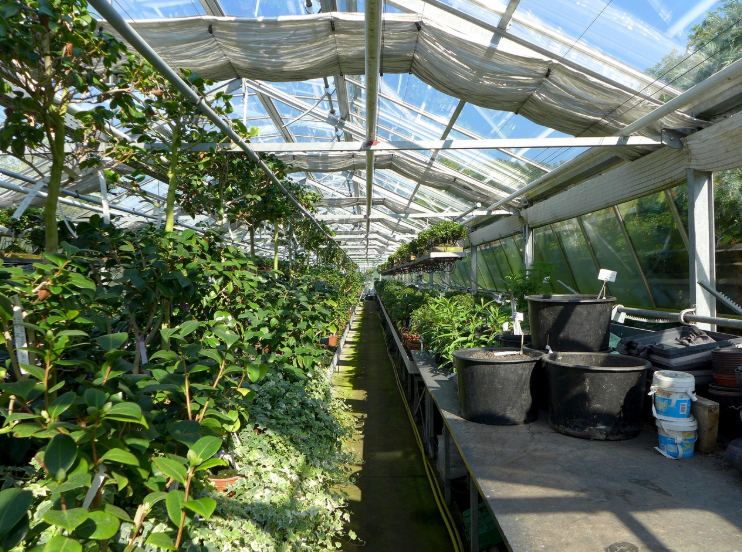
As spring day length increases across North America in April, solar radiation accumulation and substrate moisture levels become the two most reliable inputs for automating smart irrigation in greenhouses and controlled environments.
Instead of relying on fixed time-based schedules, growers who integrate solar meters and substrate sensors into their fertigation platforms deliver water precisely when plants demand it — and withhold it when they don’t.
Climate Control Systems Inc.’s Fertigation Manager™ supports both trigger types, allowing commercial growers to build irrigation logic that responds to actual environmental conditions rather than a clock.
How Solar Radiation Triggers Irrigation
Plants transpire in direct proportion to the light energy they receive. As photosynthetically active radiation (PAR) increases through the day, stomata open wider, transpiration rises, and water demand climbs with it.
Solar integrator controllers measure accumulated radiation in joules per square centimeter (J/cm²) and trigger an irrigation event once a set threshold is crossed — typically between 100 and 200 J/cm² per shot, depending on crop and substrate type.
This approach, often called radiation sum or light integral triggering, links water delivery directly to photosynthetic activity.
On bright Summer days when DLI (daily light integral) peaks, plants receive more frequent, smaller irrigation events that keep substrate moisture within the optimal vegetative or generative window.
On overcast days, fewer triggers fire and less water is applied, preventing overwatering that can suppress root oxygenation and drive disease pressure. The Fertigation Manager™ can be configured to trigger irrigations based on solar accumulation, making the system responsive to real-time light levels without manual intervention.
Substrate Moisture Sensors and the Dry Back Method
While solar triggers determine when to irrigate based on energy load, substrate moisture sensors confirm how much water remains in the root zone and whether a dry back target has been reached.
Volumetric water content (VWC) sensors placed at mid-slab or mid-container depth give growers a continuous read of substrate saturation, expressed as a percentage of total pore space.
The dry back method uses this data deliberately. Growers allow VWC to drop by a target percentage from peak saturation before the next irrigation event fires — a technique that steers plants between vegetative and generative growth phases.
In vegetative stages, shallow dry backs keep plants in an active, shoot-dominant state. Generative phases targeting fruit set or cannabinoid development use deeper dry backs or more to build mild stress signals that promote flowering and reproductive investment.
Combining solar triggers with VWC feedback creates a layered control logic: radiation accumulation sets the irrigation cadence based on energy input, while moisture sensors enforce a floor VWC below which an event trigger regardless of light conditions — a safety net against substrate drying beyond recovery.
Spring-Specific Scheduling
April presents a transitional light environment in most growing regions. Solar radiation ramps steeply week over week, meaning radiation sum thresholds that were appropriate in March may underwater crops by mid-April if left unadjusted.
Reviewing and stepping down J/cm² thresholds every one to two weeks through spring keeps irrigation frequency aligned with rising plant demand
Smart irrigation systems leveraging sensor-based scheduling reduce water use by 30–50% compared to time-based programs, according to U.S. EPA WaterSense data, while maintaining or improving crop quality.
Contact Climate Control Systems
For sustainable food production and ornamental growers alike, integrating solar and moisture inputs into a unified automation platform, as offered by the CCS Fertigation Manager™, transforms the variable light conditions from a scheduling challenge into a precision advantage.
Contact us today!